
“The family which takes its [...] car out for a tour passes through cities that are badly paved, made hideous by litter, blighted buildings, billboards, and posts for wires that should long since have been put underground. [...] Is this, indeed, the American genius?” — John Kenneth Galbraith, The Affluent Society, 1958
* * *
MAMEC is the alliance of municipalities and organizations supporting legislation to allow new municipal electric utilities (or munis) in Massachusetts (the "Muni-Choice Bill" H2866) – beyond 41 munis that already exist – so that cities and towns have a choice for electricity distribution. Here is a presentation about this issue.
Our current State law includes century-old, obsolete language that gives investor-owned utilities (or IOUs) veto power over new munis: no Massachusetts community has formed a muni since 1926.
LATEST NEWS: Representative Michael Kushmerek and Senator John Cronin have refiled the Muni-Choice bill as H3331, An Act relative to the establishment of municipal lighting authorities for the 2021-22 legislative session.
Senator Dean Tran refiled the Muni-Choice bill as SD2492 for the 2018-19 legislative session.
Representative Stephen DiNatale (D Fitchburg) led 18 State legislators in refiling the Muni-Choice bill for the 8th time for the 2015-2016 legislative session, as Bill H2866 “An Act relative to the establishment of municipal lighting authorities”, with Representatives James Arciero (D Westford), Jennifer Benson (D Lunenburg), Leah Cole (R Peabody), Kimberly Ferguson (R Holden), John Fernandes (D Milford), Sheila Harrington (R Groton), Randy Hunt (R East Sandwich), Jay Kaufman (D Lexington), Leonard Mirra (R West Newbury), William Smitty Pignatelli (D Lenox), Denise Provost (D Somerville), Dennis Rosa (D Leominster), Ellen Story (D Amherst), Chris Walsh (D Framingham) and Jonathan Zlotnik (D Gardner) and Senators James Eldridge (D Acton) and Jennifer Flanagan (D Leominster). The Massachusetts Municipal Association (MMA) supports this legislation.
In March 2014, the Muni-Choice bill H2927 died for the 7th time in 7 legislative sessions (14 years) when the Legislature's Joint Committee on Telecommunications, Utilities and Energy sent it to "study".
Representatives Stephen DiNatale (D Fitchburg) and Jay Kaufman (D Lexington) led 22 State legislators in refiling the Muni-Choice bill for the 7th time for 2013-14 (H2927), with Representatives James Arciero (D Westford), Cory Atkins (D Concord), Jennifer Benson (D Lunenburg), Linda Campbell (D Methuen), Thomas Conroy (D Wayland), James Dwyer (D Woburn), John Fernandes (D Milford), Randy Hunt (R East Sandwich), Kevin Kuros (R Uxbridge), Jason Lewis (D Winchester), Paul McMurtry (D Dedham), Sarah Peake (D Provincetown), William Smitty Pignatelli (D Lenox), Denise Provost (D Somerville), Dennis Rosa (D Leominster), Thomas Stanley (D Waltham) and Chris Walsh (D Framingham) and Senators James Eldridge (D Acton), Jennifer Flanagan (D Leominster) and Michael Knapik (R Westfield).
Join our new email list-serve http://groups.yahoo.com/group/lex-electric to discuss:
- electricity distribution in Massachusetts (outages, reliability, rates, double poles, undergrounding wires, etc);
- Eversource, National Grid, Unitil;
- Massachusetts' 41 munis, and the Muni-Choice bill about forming new ones.
To join, send an email to lex-electric-subscribe@yahoogroups.com
Muni-Choice Bill killed in June 2012 for the 6th time in 12 years: On June 27, 2012, 14 Representatives led by Rep Jay Kaufman filed the Muni-Choice bill -- which had been favorably reported out as H3896 by the Joint Committee on telecommunications, Utilities and Energy, but with language that values IOU assets at “50 percent of the net book value, plus 50 percent of the reproduction cost new less depreciation”, well above “unamortized investment” which State law uses for streetlights -- with improved language as amendment #15 to bill H4198 (also known as S2214) “relative to competitively priced electricity in the Commonwealth”. During debate of S2214 on the House floor, the amendment was ruled beyond the scope of S2214 by Speaker Pro Tem Haddad which a roll-call vote (119 Yeas, 34 Nays) affirmed, killing the Muni-Choice bill for the 2011-12 session.
* * *
Supporters of the Muni-Choice Bill include the MMA (Massachusetts Municipal Association), the Boston Globe and Governor Deval Patrick who wrote "The bills under consideration are a step in the right direction and will allow residents greater local control and input into utility investment policies and decisions, services and service levels. I look forward to reviewing the final bill when it reaches my desk." when signing our petition and said "I see [...] municipal electric utility companies adding competition and lowering consumer prices".
Opponents are the 4 Massachusetts IOUs, NStar, National Grid, Unitil and Western Mass Electric who "have spent more than $4.6 million [...] lobbying since 2005" against the Muni-Choice Bill and other legislation, according to the New England Center for Investigative Reporting at Boston University. The Boston Globe reports that "in 2010, [NStar CEO] Tom May made $7.9 million to run the monopoly that is NStar".
IOUs (like Eversource) charge consistently more than munis: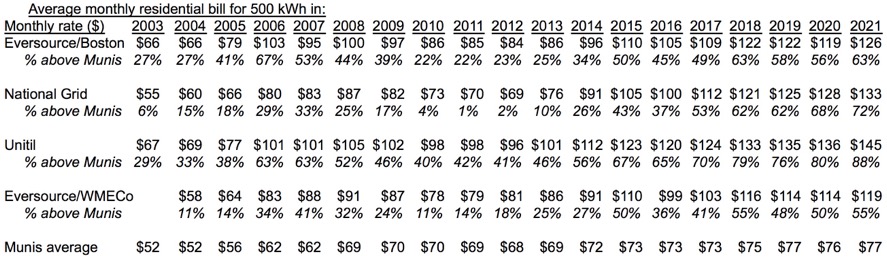
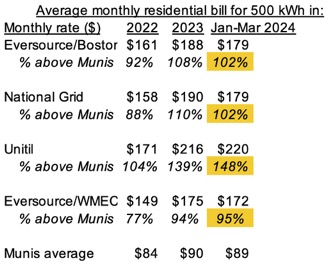
Source: MMWEC surveys for residential usage of 500 kWh per month
* * *
News: 2,700 people have signed a petition asking the Legislature to allow new munis in Massachusetts. Here is information about the petition and here are comments people made.
Here are the economics of a Fitchburg, Lunenburg, Townsend, Ashby muni replacing Unitil.
Here is our annotated summary of the January 28, 2010 DOER report about munis, prepared pursuant to section 107 of the Green Communities Act. Here is a July 2016 MAPC white paper about muni Clean Energy Initiatives.
Here is what happened at the Legislature's public hearing on the muni bill in September 2009.
* * *
Compared with IOUs, munis offer lower residential rates (table above) and:
> cheaper electricity for businesses and schools: if NStar charged as little as munis, NStar customers would save about $750 million each year on their electric bills.
> better reliability (fewer and shorter outages) and better customer service.
In JD Power's 2012 customer satisfaction surveys, National Grid and NStar were 73rd and 83rd out of 95 utilities scored by both their residential and business customers across the nation.
Munis restored power in 1-2 days after tropical storm Irene in 2011, but it took NStar and National Grid 1 week (Boston Globe, Herald News, Patriot Ledger). The Mansfield muni restored power to 99% of its customers who lost it in just 16 hours after Irene hit. After hurricane Sandy in 2012, the Littleton and Groton munis restored power remarkably fast as well.
It took Unitil 2 weeks to restore power in central Massachusetts after the Dec 2008 ice storm, but a few days for neighboring munis (Boston Globe, Worcester Telegram).
Here is our testimony to DPU on how munis restore power faster than IOUs after major storms.
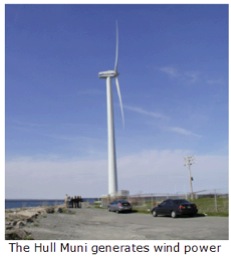
> more renewables and conservation: munis develop solar systems (with battery backup), wind projects (10 wind turbines on Brodie Mountain: below), use green energy and promote energy efficiency. As of 2015, the first 3 cities in the US whose power is 100% renewable were all served by munis: Burlington VT, Greensburg KS, and Aspen CO. In July 2016, the MAPC published a white paper about munis, Spotlight on Clean Energy Initiatives.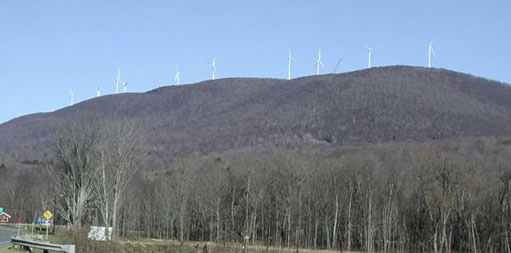
> greater responsiveness to local priorities: underground wires for better aesthetics and reliability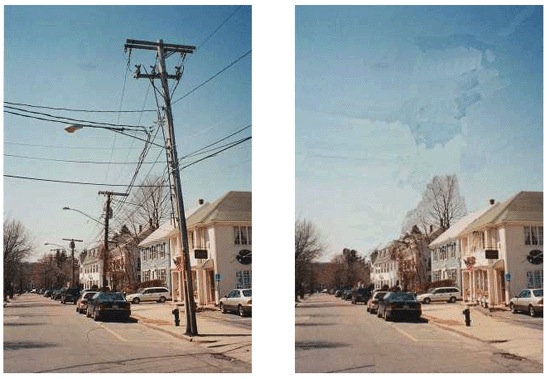
Lexington now (NStar) and right: Lexington with a Muni?
Watch a 13-minute video about why new munis are needed, and follow the presentation.
State law already includes a process for a city or town to form a muni by acquiring the IOU's local assets at fair value. But the century-old language effectively gives IOUs a veto over new munis. As a result, no muni was formed in Massachusetts since 1926. The Muni-Choice bill modernizes the State law and gives municipalities the option to form a muni.
The Muni-Choice bill will introduce competition in the distribution of electricity: even if very few munis are created, IOUs will have an incentive to keep their customers satisfied and offer lower rates, something they have not needed to worry about for many decades.
Watch a 1-hour TV program about munis and why Massachusetts needs more munis.
Read the white paper prepared for Governor Deval Patrick's transition team in 2006.
Join MAMEC's efforts: support the muni bill and ask your State legislators to also support it.